Domain 3
Instruction
Student Engagement and Lesson Adjustment
Creating and implementing engaging instruction is one of my greatest passions. Using movement and hands-on activities are some of my favorite ways to engage my students in learning. I am aware that some schools provide a scripted curriculum for their teachers to follow. While these curriculums are a great place to start, there are so many ways that teachers can bring more excitement to their lessons. Involving students as a participant in a lesson rather than an observer is helpful when teaching; people typically remember topics better if they are involved in the learning rather than verbally told the information.
Using results from instruction to gauge teaching is also a crucial aspect of teaching. There are often going to be students who do not perform well on a check-in assessment at the end of the class. Some teachers may look at this and atone this to the student not paying attention or not trying hard enough. I feel that teachers should take a step back and consider that they were not teaching in a way that was conducive to that specific student, and to try explaining the topic a different way the following day.
The artifacts within this domain continue to talk about the importance of striving to reach and engage all students and meeting student where they are at.
Teacher Assessment Work Samples
A major part of instruction is assessing the students in order to further gauge planning, and thus, later instruction. With the Teacher Assessment Work Samples (TAWS) assignment included to the right, I was able to see what my students already knew about place value and build off that knowledge. My assessment of students came in various different forms including whole group question/answer sessions, using manipulatives independently to solve an application question, working in teacher-led small groups to make connections from one topic to the next, and many more. Using assessment in instruction (3d) and questioning and discussion types (3b) helped me understand what areas I needed to focus on more.
Furthermore, many students were being pulled out of the classroom at different points due to pull-out services from reading specialists, special education teachers, and occupational therapists. This meant having to change and adjust lessons not only due to assessment, but also because of changes in schedule. This encapsulates Danielson's domain entitled demonstrating flexibility and responsiveness (3e).
Introduction to the Plant Cycle: Sequencing the Parts of a Plant
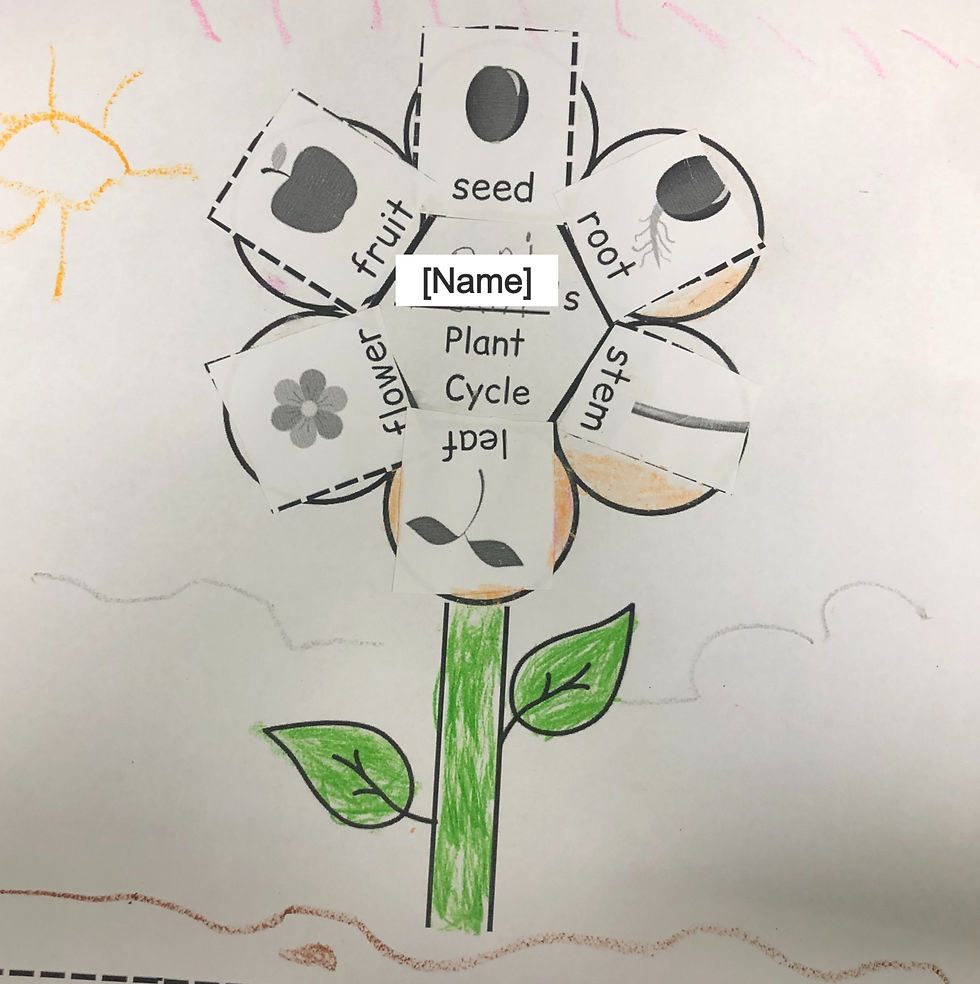
Similar to the previous artifact, this lesson was also taught during my student teaching experience. Leading up to this lesson, the students were learning about the different parts of a plant and their purposes, but I wanted to show the students how these parts connected within the plant cycle. I utilized the 6E science lesson plan model to engage students and teach new information using prior knowledge. Throughout the lesson the students stood to sing a song, worked in small groups to complete a puzzle, made observations about seeds, and completed an activity about the plant cycle independently. I knew that my students often get excited when materials are presented, so I made sure to set clear expectations and explain the purpose of the content prior to handing them out (3a). Though this lesson was about 75 minutes, I was able to engage students for the entire duration. Engaging students in learning (3c) is a crucial skill for educators to have because it is what makes learning fun!
Below, I have attached some student work samples from this activity. All of the students worked individually to create these beautiful flowers!